Dr. Pillai’s Ashtaang · Patient information
Janu Basti: Ayurvedic care for the knees
Janu Basti is a local Ayurvedic procedure in which medicated oil is retained over the knee within a boundary made from black gram dough. It is an external treatment, selected after a physician assesses your knee symptoms and overall health. At Dr. Pillai’s Ashtaang, the procedure and choice of oil form part of an individual care plan. [A1]
Plan a consultation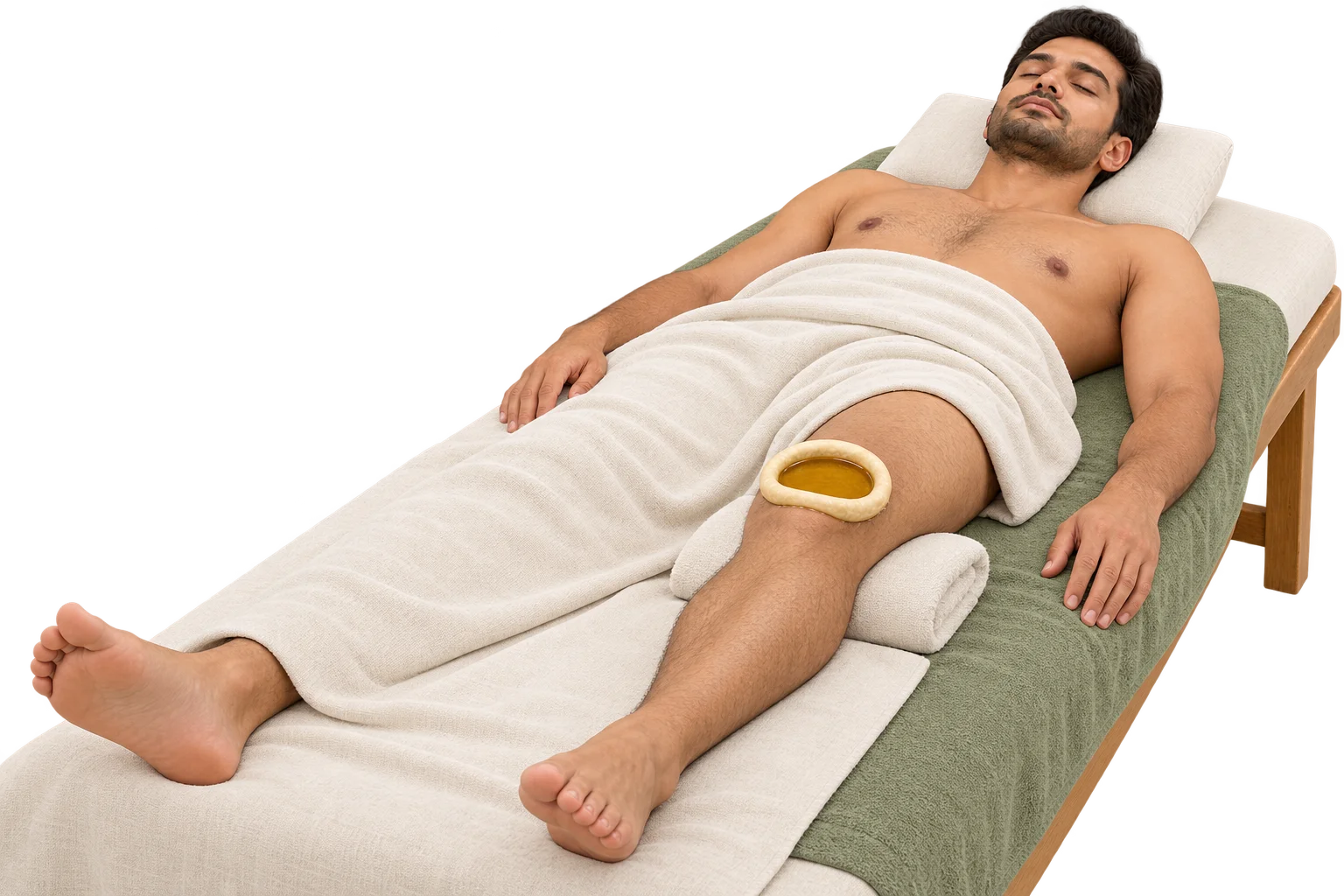
The Ayurvedic perspective
Ayurveda considers joint pain and stiffness through a broader clinical assessment, including the pattern of Vata involvement. Sandhigatavata is a traditional joint disorder discussed in Ayurveda and compared with osteoarthritis in clinical literature. The two terms should not be used to diagnose every painful knee in the same way. [J1]
The use of oil and warmth belongs within the Ayurvedic approach to selected Vata conditions. [A2] When Janu Basti is considered, the clinical goal is to support comfort and useful movement. Your plan may also include diet and lifestyle advice, medicines or other care. The procedure is not automatically the right choice for every swollen, injured or painful knee.
Understanding your knee before treatment
Tell your physician how the knee affects walking, stairs, sitting down or getting up. Describe any swelling, injury, locking or giving way, and bring relevant reports if you have them. This helps the consultation focus on what matters in your daily life as well as the reason for the symptoms.
A very painful knee, inability to put weight on it, major swelling or changed shape needs prompt medical assessment. A hot or red knee with fever or feeling unwell also needs urgent assessment rather than a routine therapy visit. [J2]
The treatment experience
The selected oil is held externally around the knee for a prescribed period. The treatment uses comfortable warmth, and you should tell the team immediately if you feel excessive heat, itching or increased pain. This is not an injection into the joint. The physician decides whether one or both knees need attention and how this fits with the rest of your care. [A1]
Timing and repeat visits
Indicatively, Janu Basti takes about 30–45 minutes, with a course commonly planned over 7–14 days. The physician decides the actual course and spacing of visits. If both knees are being considered, ask how this affects the appointment schedule. These timings are a guide for planning, not a fixed package or a promise of a particular result.
Treatment is outpatient, with no overnight admission or accommodation. Discuss practical arrangements for getting to the clinic, especially if walking is difficult or you need someone to accompany you.
Before and after your session
Bring a current medicines list and mention allergies, skin problems around the knee, reduced sensation, recent injections, surgery or injury. This allows the physician to judge suitability and coordinate your care. Ask for individual advice about meals, clothing and preparation; avoid changing existing treatment on your own.
Before you leave, clarify bathing and activity advice and when to return. Discuss how to fit treatment around walking, exercise or rehabilitation already recommended to you. At follow-up, explain whether comfort and everyday movement have changed. If you develop a rash, increased swelling or worsening pain, seek advice before another session. Skin irritation is a possible reaction to local treatment. [J1]
Evidence and realistic expectations
Research is examining Janu Basti within broader Ayurvedic treatment plans. A published 2025 study protocol describes a regimen combining Janu Basti, medicinal Basti and oral medicines for knee osteoarthritis; that publication describes the study methods, not completed efficacy results. It cannot establish the benefit of Janu Basti alone. [J1] We do not promise that oil treatment regrows cartilage, repairs a torn ligament or prevents the need for other care.
Questions patients ask
Is Janu Basti suitable for knee osteoarthritis?
It may be considered after assessment as part of an Ayurvedic care plan. Symptoms, examination findings, mobility, other health conditions and current treatment all matter when deciding whether it fits your needs.
Does the oil enter the knee joint?
The oil is applied to the skin externally. Janu Basti does not involve an injection. We do not describe the treatment as directly refilling joint fluid or rebuilding cartilage.
Do both knees need treatment?
Not necessarily. Discuss each knee’s symptoms with the physician; the plan is based on your assessment rather than a standard two-knee package.
How many sessions should I expect?
The indicative range is 7–14 days, but the physician decides the number and schedule of visits. Your response and follow-up assessment guide any change to the plan.
Arrange a consultation
For an appointment at Dr. Pillai’s Ashtaang in Ambernath, call or WhatsApp reception on +91 95521 28485 during working hours. Start with a consultation so that the physician can discuss your knee concerns and the care options available.
Further reading
References
- [A1] Department of AYUSH. Ayurveda: The Science of Life (2012), chapter 5, p.60. Read source
- [A2] Charak Samhita online. Vatavyadhi Chikitsa. Read source
- [J1] Rai AK et al. Multimodal Ayurveda for knee osteoarthritis: study protocol. JMIR Res Protoc. 2025;14:e68306. Read source
- [J2] NHS. Knee pain. Read source