Dr. Pillai’s Ashtaang · Patient information
Kati Basti: Ayurvedic care for the lower back
Kati Basti is an external Ayurvedic treatment in which medicated oil is held over the lower back within a soft boundary made from black gram dough. At Dr. Pillai’s Ashtaang in Ambernath, the physician selects the oil and treatment plan after a consultation. The aim is to choose care that fits your back symptoms, health and everyday needs. [A1]
Plan a consultation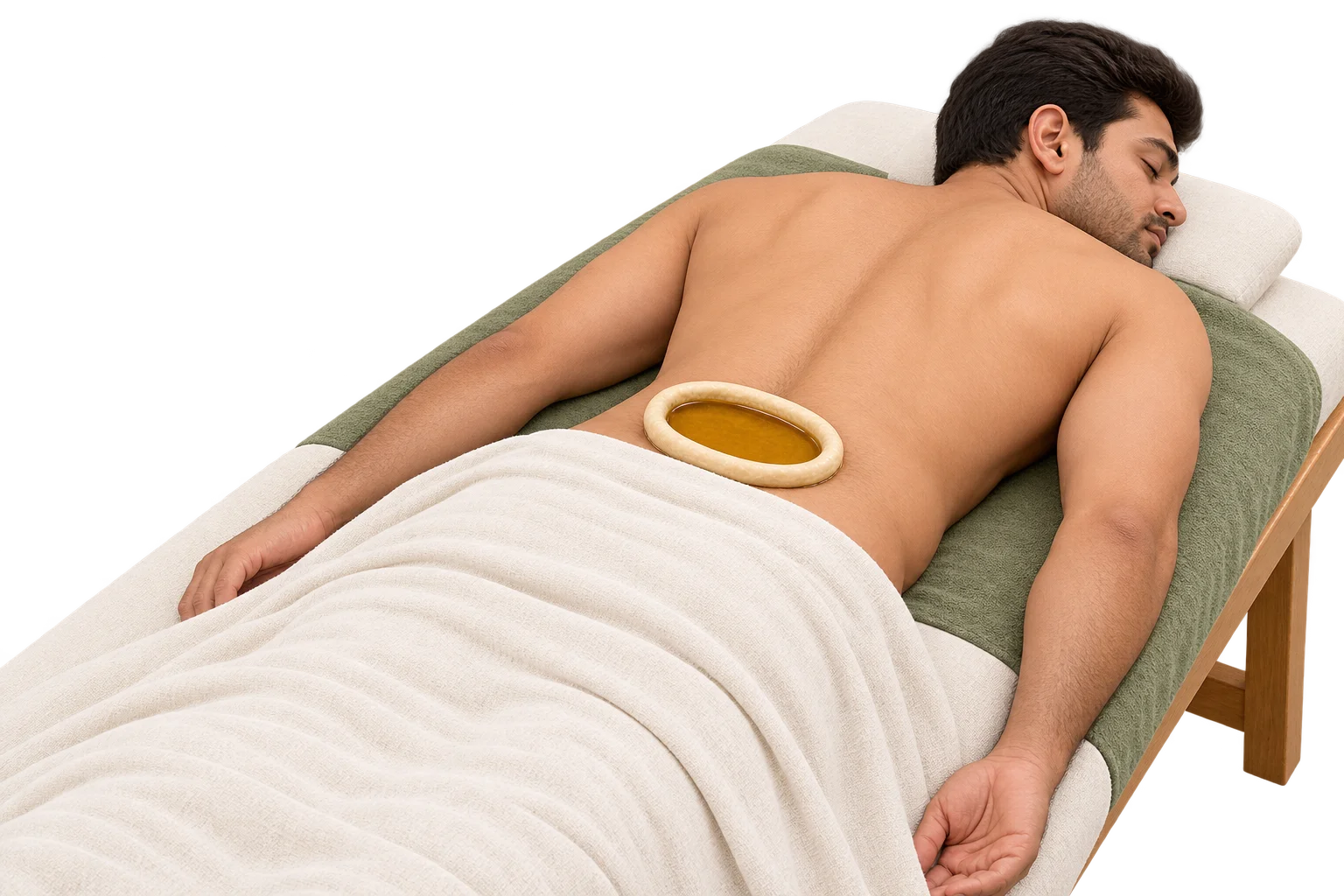
Its place in Ayurvedic care
Ayurveda uses snehana, or therapeutic oleation, and swedana, or therapeutic warmth and sudation, within the care of selected Vata disorders. Kati Basti brings local oil application and warmth to the lower-back region. This is an Ayurvedic treatment rationale; it does not mean that oil repairs a disc or removes pressure from a nerve. [A2]
Persistent discomfort, stiffness or difficulty with daily movement can be reasons to discuss treatment. A consultation comes first because symptoms that seem similar may need different care. Tell your physician whether the pain stays in your back, travels into a leg, follows an injury or comes with altered sensation. The procedure is selected as part of your individual plan, rather than automatically prescribed for every back complaint.
What happens during a visit
The treatment focuses on the lower back. A dough boundary holds the selected oil over this area for the prescribed period. You remain in a position that allows the area to be treated; tell the team if your back, breathing or comfort makes that position difficult. The oil should feel comfortably warm. Speak up straight away if it feels too hot, causes itching or increases discomfort. This overview explains the experience, rather than instructions for doing the procedure yourself. [A1]
Allowing time for treatment
A Kati Basti session is usually planned for about 30–45 minutes. An indicative course is 7–14 days, with the actual number and spacing of visits decided by the physician. This is a planning range, not a fixed package or a promise that symptoms will settle within that time. Ask reception how much time to allow for your complete visit, including any consultation or other care.
Ashtaang is an outpatient clinic. There is no overnight stay or accommodation, so discuss your travel and work arrangements when planning repeated visits.
Preparing for your appointment
Bring relevant reports and a list of medicines, supplements and treatments you already use. Mention allergies, any rash or broken skin over the back, reduced skin sensation, pregnancy, recent surgery or difficulty lying in one position. Your physician will decide whether treatment should proceed, be adapted or wait. Ask for your own instructions about meals, clothing and any additional preparation; do not change existing medicines solely because a procedure has been booked.
Back pain with new difficulty passing urine, loss of bladder or bowel control, numbness around the genital or buttock area, or marked new weakness in both legs needs urgent medical assessment. Do not wait for a therapy appointment in these circumstances. [K2]
Aftercare and follow-up
Before leaving, clarify the advice for bathing, activity, travel and your next visit. Discuss what you would like to do more comfortably—such as sitting at work, walking or sleeping—and bring those observations to follow-up. If skin irritation, worsening pain or new symptoms develop, seek advice rather than assuming they are a necessary part of treatment. Diet, lifestyle advice, medicines or other procedures may form part of the wider plan when appropriate.
What research can tell us
A small 2024 trial compared a residential yoga programme with the same programme plus Kati Basti in 40 people with chronic low-back pain. Both groups improved, but the study did not find a significant difference between them in pain, disability or depression. It therefore does not establish an added benefit for those outcomes from Kati Basti. Larger, well-designed studies are needed to clarify its contribution. These findings also do not predict an individual patient’s result at Ashtaang. [K1]
Questions patients ask
Is Kati Basti the same as medicinal Basti?
No. Kati Basti keeps oil externally over the back. Medicinal Basti uses a different route and has its own indications, preparation and supervision.
Can I book a course without a consultation?
Start with an assessment. The physician will discuss whether Kati Basti is suitable and whether other care is needed before arranging a course.
Will it cure a slipped disc or sciatica?
We do not promise that Kati Basti repairs a disc or cures sciatica. Pain travelling into a leg needs assessment, especially if accompanied by numbness or weakness. Your diagnosis and examination guide the plan.
Can I return to work after a session?
Discuss your work, travel and physical demands with the physician. Your aftercare advice and comfort determine what is sensible for you; a standard session length is not a guarantee of immediate return to every activity.
Arrange a consultation
To discuss lower-back care at Dr. Pillai’s Ashtaang, call or WhatsApp reception on +91 95521 28485 during working hours. Appointments are preferred. Reception can help arrange a consultation and explain the visit arrangements.
Further reading
References
- [A1] Department of AYUSH. Ayurveda: The Science of Life (2012), chapter 5, p.60. Read source
- [A2] Charak Samhita online. Vatavyadhi Chikitsa. Read source
- [K1] Bhatta M et al. Kati Basti and yoga trial. J Ayurveda Integr Med. 2024;15(4):101030. Read source
- [K2] St George’s University Hospitals. Back Pain Advice. Read source