Dr. Pillai’s Ashtaang · Patient information
Localized Ayurvedic therapies: a patient guide
Localized Ayurvedic therapies apply treatment to a selected part of the body. Some retain oil against the skin, others use a medicated pad or paste, and Agnikarma uses a distinct form of therapeutic heat application. They differ in purpose and in the care needed before and afterwards.
At Dr. Pillai’s Ashtaang in Ambernath, your physician first considers the symptoms, their cause and your wider health. The treatment area alone does not determine the therapy: two people with pain in the same place may need different plans.
Plan a consultationGreeva Basti — oil retention over the neck
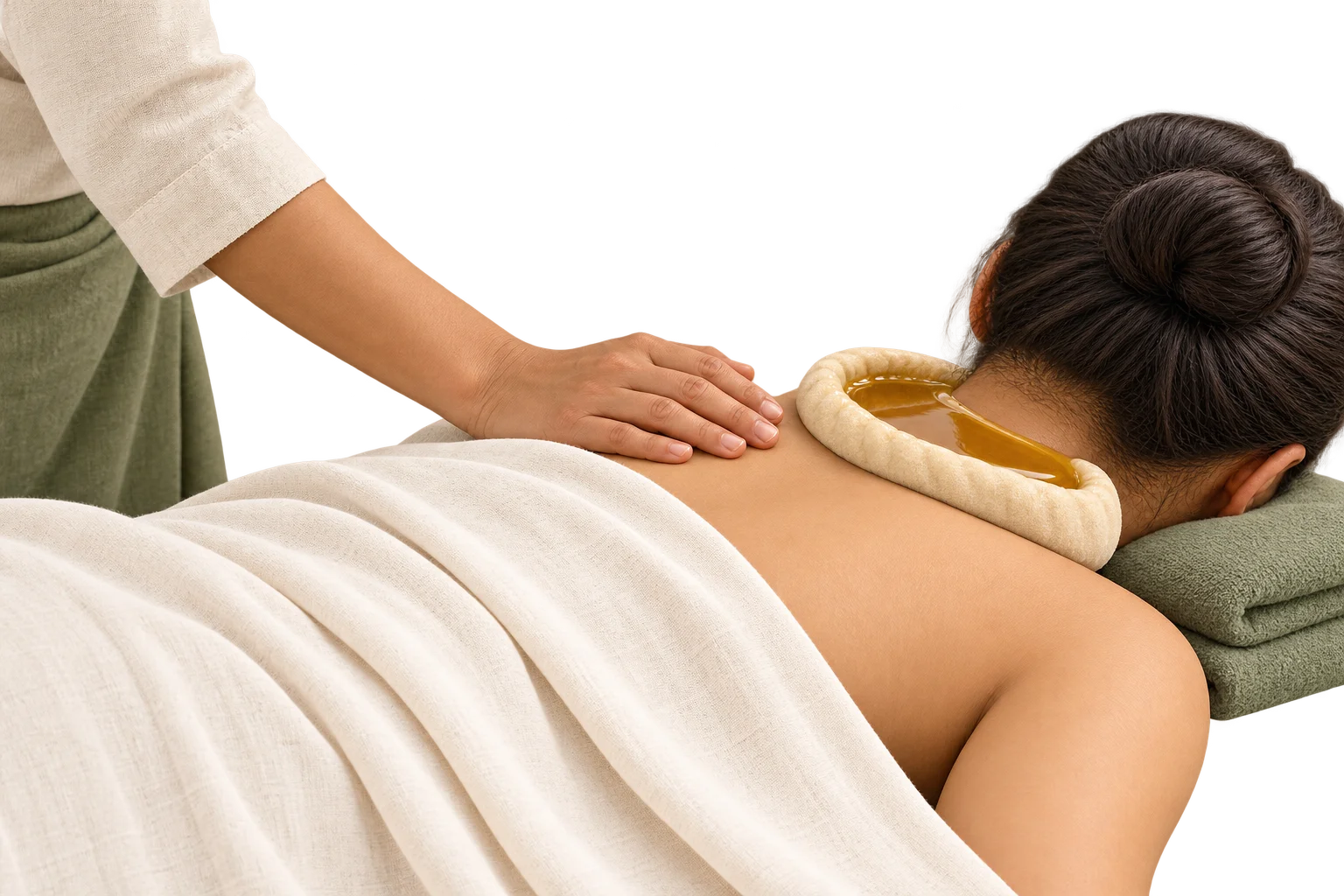
Greeva Basti, also written Greeva Vasti, retains selected medicated oil over the back of the neck within a boundary made from black gram dough. It is an external application. The word “basti” here does not refer to the medicinal enema procedure described on our Panchakarma Basti page.
Within Ayurvedic care, the physician may consider local oil treatment for selected patterns of neck discomfort or stiffness. The aim should be discussed in relation to your symptoms and movement, rather than assuming that oil applied to the skin repairs a disc or directly lubricates a spinal joint. The government Ayurveda dossier describes this neck-region application within the family of localized oil-retention procedures. [S1]
An indicative Greeva Basti session at Ashtaang is 30–45 minutes. The course and positioning are decided after assessment. Tell the physician about symptoms extending into the arm, altered sensation or weakness, and about any recent injury. These details may require further assessment before a neck treatment is planned.
Uro Basti — oil retention over the chest
Uro Basti uses a dough boundary to retain selected medicated oil on the chest. Its position on the body distinguishes it from neck, lower-back and knee oil-retention therapies. At Ashtaang, an indicative session is 30–45 minutes, and a plan may involve 7–14 treatment days.
A chest application needs a clear clinical purpose. Your physician will explain why it is being considered, review relevant reports and medicines, and decide whether it is appropriate within your care. It should not be understood as a treatment that repairs heart valves or restores heart function.
New or unexplained chest symptoms need medical assessment. Sudden persistent chest pain, pain spreading to the arm or jaw, or chest discomfort with breathlessness, sweating or feeling faint requires emergency medical help. Do not wait for Uro Basti or a routine clinic appointment. [S4]
Local Pichu — an oil-soaked pad
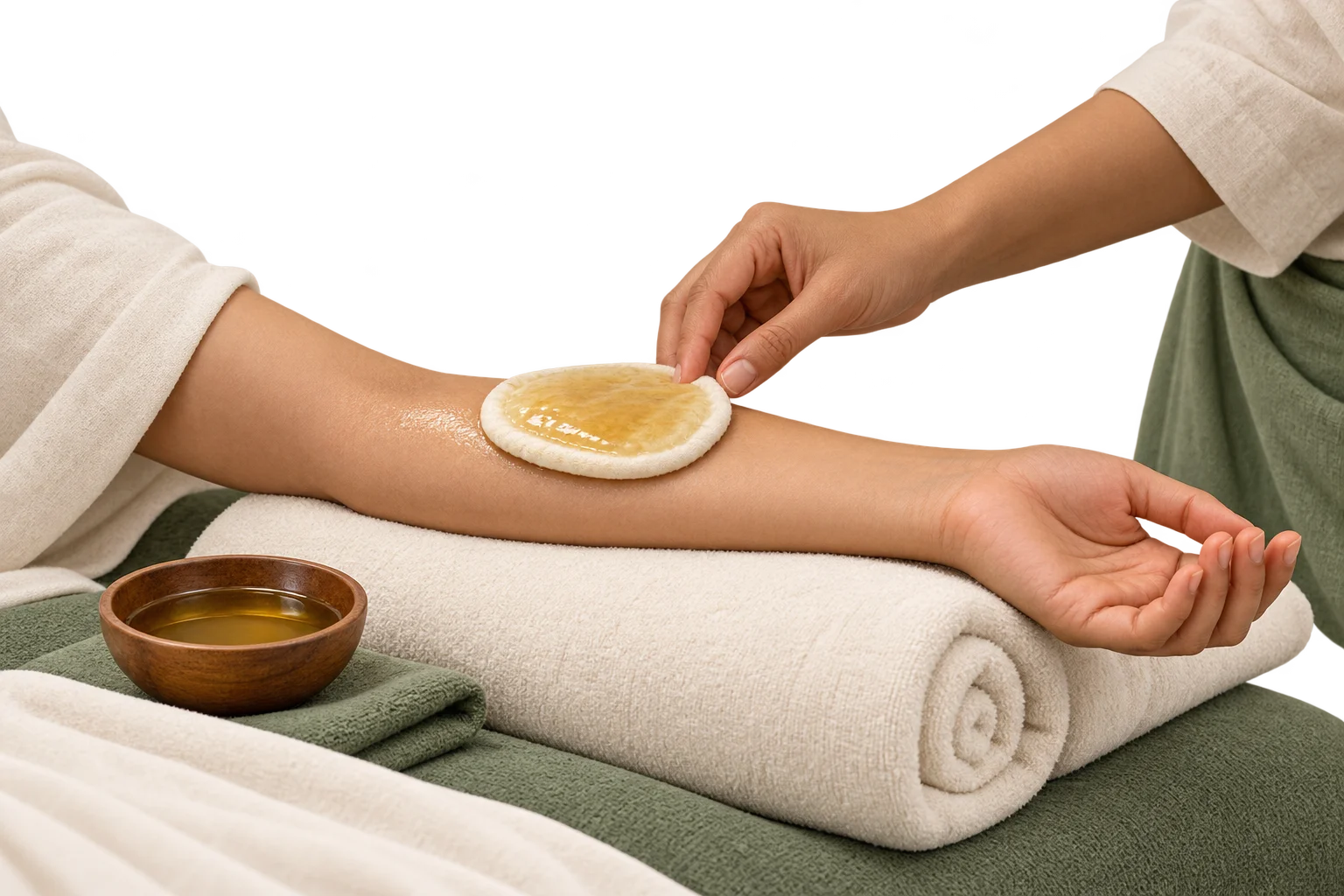
Pichu keeps a cotton pad soaked in prescribed medicated oil against a selected area for a period of time. It provides a way to maintain local contact with the oil without the dough boundary used in Basti. The physician chooses the material and site according to the treatment plan.
Local Pichu appears in Ayurvedic management guidance for selected musculoskeletal presentations; for example, the Ministry of AYUSH’s Gridhrasi guidance includes lower-back Pichu among external options. That is a context for clinical selection, not a promise that every radiating pain will improve with the same application. [S2]
At Ashtaang, the indicative application time is 20–30 minutes, with courses that may involve 7–14 treatment days. Tell the team about skin irritation, allergies or difficulty sensing warmth. Head-specific Pichu is explained separately in the head-therapies guide.
Nabhi Lepana — paste around the navel
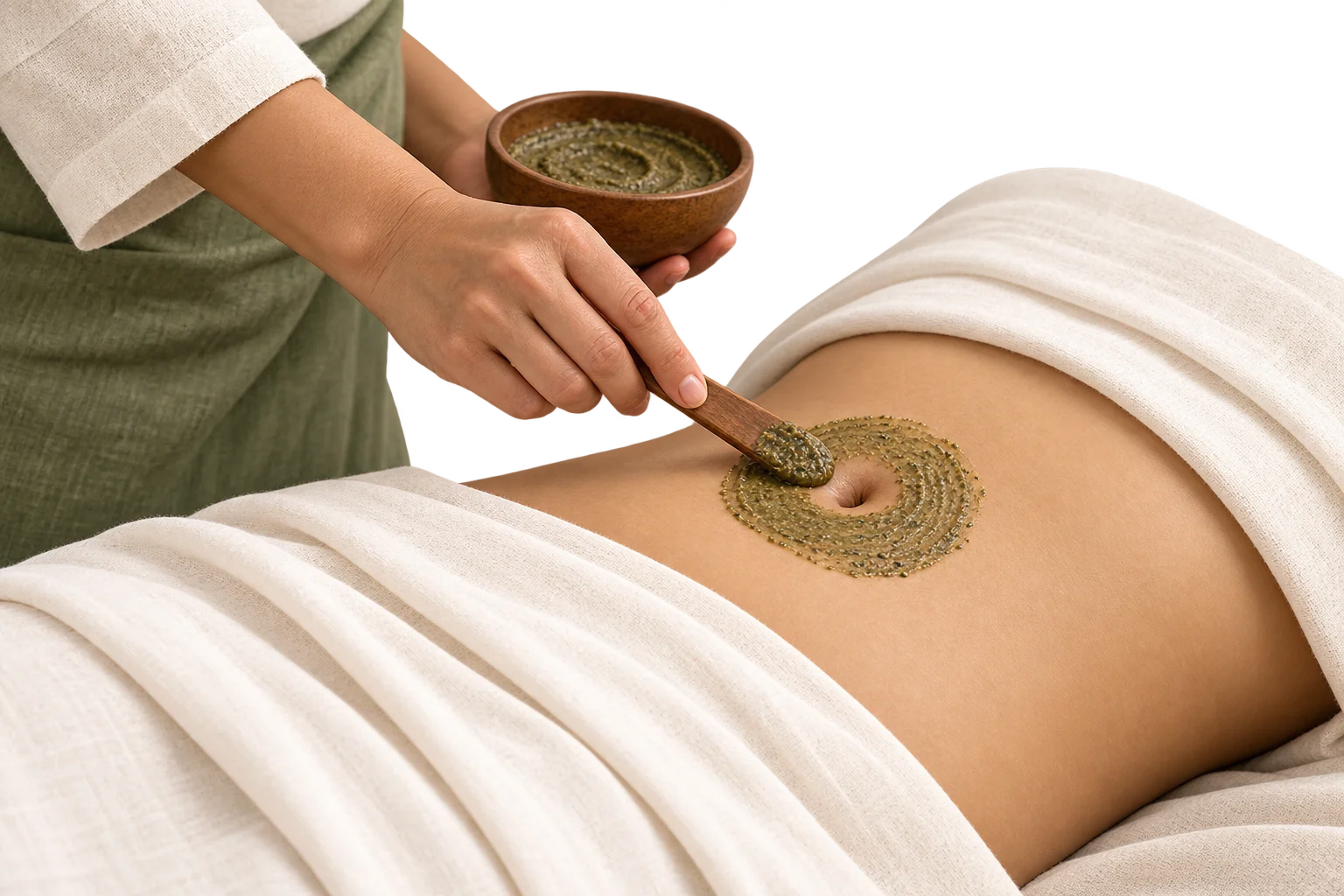
Nabhi Lepana applies a selected medicated paste to the umbilical region. “Lepana” describes an external paste application; this is different from taking medicine by mouth or retaining oil in a dough boundary.
At Ashtaang, the physician decides whether this localized application has a role in the individual plan and selects the preparation. An indicative application lasts 30–45 minutes, and a course may involve 7–14 treatment days.
Abdominal or pelvic symptoms can have several causes. Explain where the discomfort occurs, how long it has been present and any associated changes before a procedure is selected. Pregnancy, a recent operation, a hernia or broken skin near the application area are also important to mention.
The reason for using the paste should be specific to your assessment. Its placement at the navel does not establish that it treats every digestive or urinary problem.
Upanaha — a medicated poultice
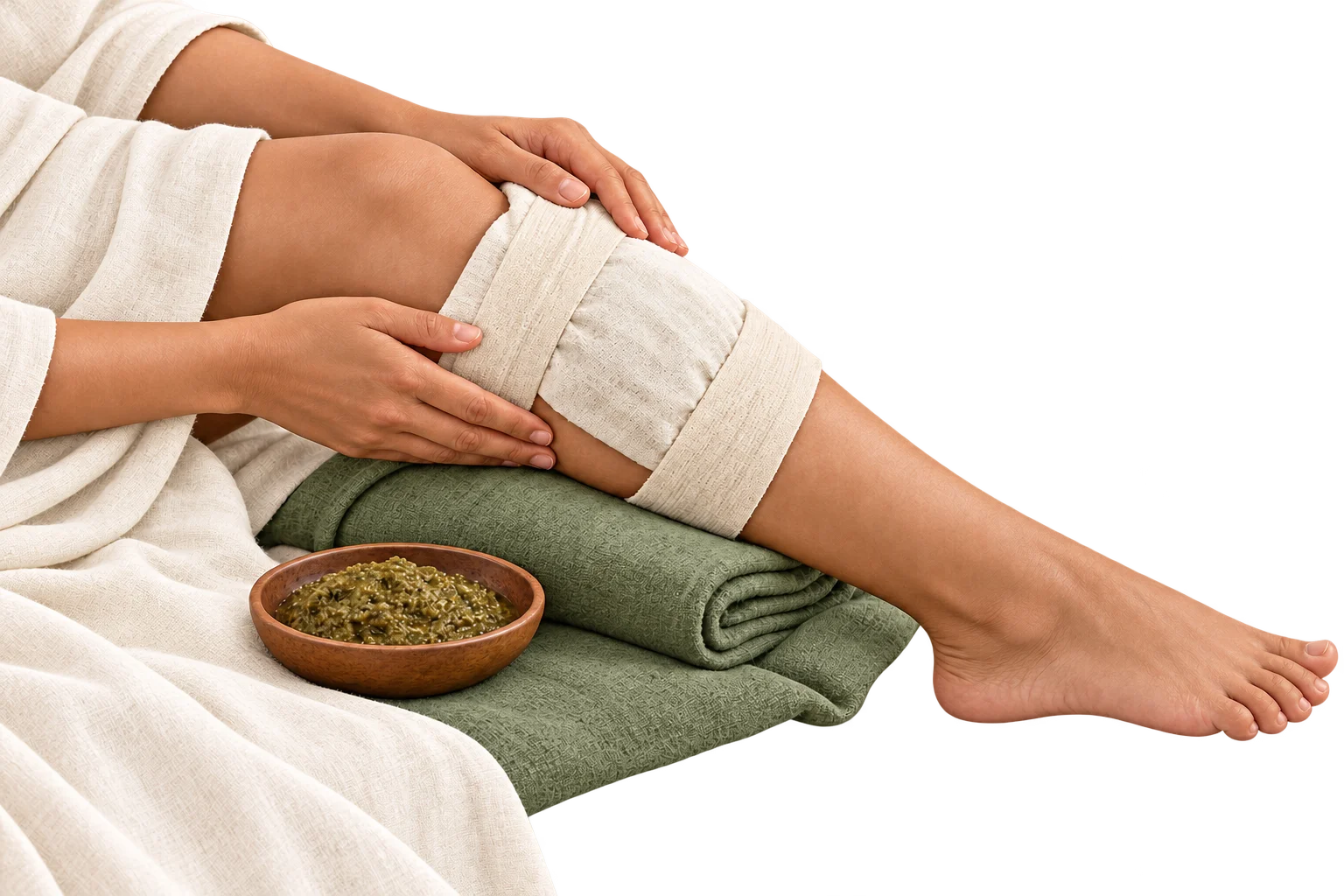
Upanaha uses a medicated paste applied to a selected area and covered or bandaged. In the Upanaha Sweda approach at Ashtaang, a warm herbal paste is used. This gives a different experience from a moving bolus treatment or a short massage.
In Ayurvedic practice, Upanaha is used in selected painful or stiff musculoskeletal presentations. Its place in treatment depends on the condition and the properties of the preparation. Ministry of AYUSH guidance discusses it among options in Avabahuka, the Ayurvedic presentation commonly associated with frozen shoulder. [S2]
The physician determines where it is applied and how long it should remain. Ask when and how it should be removed, whether movement or clothing needs adjustment, and what to do if the dressing feels uncomfortable. Do not assume that a poultice should remain overnight, or reproduce a preparation found online.
Tell the clinic promptly about burning, increasing irritation, numbness or a bandage that feels too tight. The treatment plan should include clear instructions for the application period and care afterwards.
Agnikarma — a distinct heat-based procedure
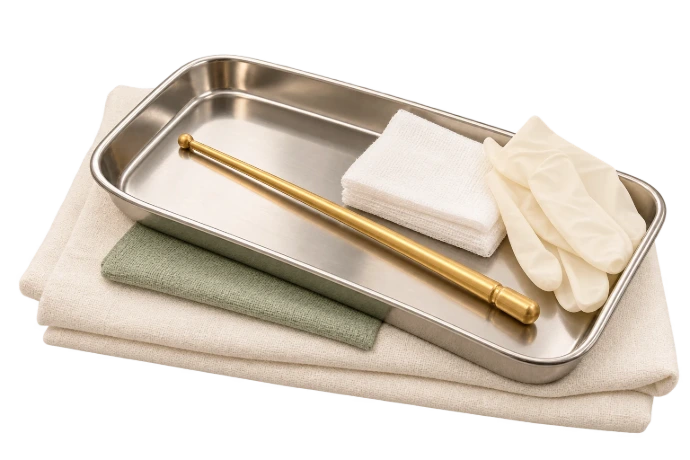
Agnikarma is an Ayurvedic therapeutic heat procedure, commonly involving a heated instrument applied at selected points. It belongs to a different category from gently warmed oil, steam or a herbal poultice. Some techniques intentionally create small superficial cautery sites that need care while healing. [S3]
Ayurvedic clinical guidance considers Agnikarma for selected painful conditions, including some situations where other approaches have not helped. The relevant site, method and suitability must be decided by a qualified clinician. It is not a general treatment for every sudden pain or a guarantee of immediate relief. [S2]
Before agreeing to treatment, discuss the expected sensation, possible skin marks, risks, alternatives and the follow-up plan. Thermal injury, infection and lasting skin changes are relevant considerations. Tell the physician about reduced sensation, diabetes, poor healing, medicines affecting bleeding, pregnancy and skin problems at the proposed site.
Preparation and aftercare depend on the technique. You should understand the care needed for the treated skin and when to return before starting. Increasing redness, swelling, discharge, fever or worsening pain afterwards needs prompt clinical advice. Do not apply heat or attempt Agnikarma yourself.
What research can tell us
Traditional Ayurvedic rationale helps explain why a treatment is selected. Research addresses a different question: what outcomes have been observed for a particular method and condition?
A small, open-label study compared Agnikarma with therapeutic ultrasound in 30 patients with tennis elbow. It reported greater improvement in pain and a patient-rated pain/function measure with Agnikarma at the day-8 and day-15 comparisons. These findings concern one condition and a specific technique; they do not establish a predictable result for other painful conditions or for every form of Agnikarma. [S3]
Likewise, the findings for one oil application or poultice should not be transferred automatically to all localized therapies. Discuss the intended benefit for your own symptoms and how progress will be reviewed. None of these treatments should be presented as guaranteed structural repair or a substitute for necessary assessment.
Preparing for your visit
Bring relevant reports and a current medicine list. For a follow-up, bring your previous prescription. Tell the physician about allergies, pregnancy, recent injury or surgery, skin problems and difficulty sensing warmth or maintaining a position.
Ask about clothing, meal timing, the full visit length and any arrangements needed afterwards. Do not fast, stop existing medicines or add home treatments simply because a procedure is planned. Advice on medicines is given after reviewing your case.
The quoted timings are indicative treatment periods, not guaranteed appointment lengths. The number and spacing of visits depend on your plan. Ashtaang provides outpatient care, without accommodation or overnight admission.
During treatment and afterwards
Let the team know if the position, warmth or application becomes uncomfortable. Increasing pain, burning or dizziness should be reported rather than tolerated. Follow the specific instructions for bathing, activity, skin care and follow-up; a simple oil application and Agnikarma do not have identical aftercare.
If a new symptom suggests that another assessment is needed, the physician may advise investigations or referral. Local treatment is one part of care, alongside medicines, diet and lifestyle advice where appropriate.
Questions patients ask
Is external Basti the same as Panchakarma Basti?
No. Greeva, Uro, Kati and Janu Basti retain oil externally over different regions. The Panchakarma procedure called Basti administers prescribed medicine through a different route.
How do Pichu, Lepana and Upanaha differ?
Pichu uses an oil-soaked pad. Lepana applies a medicated paste. Upanaha uses a paste or poultice with a covering or bandage. Selection and contact time depend on the purpose of treatment.
Can I choose a local treatment without consultation?
A consultation is needed to understand the symptoms and select appropriate care. You are welcome to discuss a procedure you have heard about.
Does Agnikarma mean the same thing as warm oil therapy?
No. It is a distinct heat-based procedure that requires its own assessment, consent discussion and aftercare.
Are Kati Basti and Janu Basti available?
Both are offered subject to physician assessment. Their separate guides explain lower-back and knee treatment in more detail.
Can I use Uro Basti for sudden chest pain?
No. Sudden chest symptoms may need emergency care. A routine therapy appointment is not an emergency service.
Arrange a consultation
Discuss your concerns with our physicians at Dr. Pillai’s Ashtaang, Kerala Ayurveda & Panchakarma Clinic, Ambernath. Call or WhatsApp reception on +91 95521 28485 during working hours. Appointments are preferred; walk-ins depend on availability.
Further reading
References
- [S1] Department of AYUSH, Ministry of Health & Family Welfare, Government of India, Ayurveda — The Science of Life (2012), hosted by CCRAS, chapter 5, printed p.60. Read source
- [S2] Ministry of AYUSH, Ayurvedic Standard Treatment Guidelines, first edition October 2017, coordinated by Rashtriya Ayurveda Vidyapeeth. Read source
- [S3] Sreelekshmi R, Raj S, Rajeshwari PN, Tripathy R. Comparing the efficacy of Agnikarma with therapeutic ultrasound in the management of tennis elbow — A randomised controlled preliminary study. Journal of Ayurveda and Integrative Medicine. 2024;15(3):100898. DOI 10.1016/j.jaim.2024.100898. ; full-text location Read source 1 Read source 2
- [S4] NHS, Chest pain. Read source